Afternoon tea looks like the easiest meal in Britain: a pot, a cake stand, a few small sandwiches. Then you sit down, and someone across the table is quietly watching your scone.
The customs aren't there to catch you out. They exist so that a slow, sociable meal runs smoothly, and once you know the handful of things that genuinely matter, you can stop thinking about them and get on with the tea.
What Afternoon Tea Is (and Isn't)
Afternoon tea is a light meal taken between roughly three and five, built around tea, finger sandwiches, scones and small cakes. The usual story credits Anna, the seventh Duchess of Bedford, with starting the habit in the 1840s, when the gap between lunch and a late dinner felt too long to bear. Dinner in her circle was served around eight in the evening, luncheon was early and light, and by four o'clock she was, by her own account, feeling a "sinking feeling". A tray of tea, bread and butter and cake was the answer. Her friends copied her, and then everyone else did.
What began as a private snack in a bedroom became a social institution. By the end of the nineteenth century it had a menu, a dress code and a firm place in the day. Today it survives in two forms: the domestic version, which is a pot of tea and whatever cake happens to be in the tin, and the ceremonial version served in hotels, tearooms and country houses, where the whole thing is staged on a three-tier stand.
It is not high tea. High tea is the older, plainer, more substantial working supper: hot dishes, bread and butter, a pot of tea, eaten around six at the "high" table. Nor is it a cream tea, which is simply scones with jam and clotted cream and nothing else. Afternoon tea is the dressed-up version — three tiers, small portions, a bit of ceremony.
One more warning for visitors. In much of northern England, Scotland and Ireland, "tea" on its own means the evening meal, and "tea time" can mean six o'clock and a plate of something hot. If a colleague invites you for tea, it is worth asking which one they mean.
The Tier Order: Start at the Bottom
The cake stand has a sequence. Follow it and the flavours make sense.
Bottom tier — sandwiches
Finger sandwiches: cucumber, smoked salmon, egg mayonnaise, ham. Crusts off, cut small, made to be picked up in one hand. Take one or two rather than stacking a plate, and finish these before moving up.
Middle tier — scones
Plain or with raisins, with jam, clotted cream or butter. This is the heart of the meal, and the part people are quietly judging.
Top tier — cakes and pastries
Fruit tartlets, éclairs, macarons, a slice of battenberg. Sweet things come last, so the meal finishes sweet rather than muddled.
Plenty of hosts ignore the order, and that's fine. If you're unsure, working from the bottom up is never wrong.
Scones Without the Argument
You will hear about the jam-and-cream question. You do not need to take a side, but you do need to know what is happening.
In Devon, clotted cream goes on first, then jam on top. In Cornwall, jam goes on first and the cream is dolloped over it. Both counties are certain the other is wrong, and the argument is at least a century old. The practical difference is small: cream first gives you a smoother base, jam first a firmer one. Whichever order your host uses is the correct order for the afternoon. If you are pouring for yourself, pick one and do it with confidence — hesitation is the only real mistake.
The rest is simpler than people make it sound. Break or split the scone rather than sawing it into thin layers — fingers are allowed, a knife is also allowed, but a four-storey sandwich is not. Put the jam and cream on the edge of your own plate, or straight onto the scone, never into the communal pot. Eat it in two or three bites rather than in one heroic mouthful, and if you only want half, leave the other half neatly on your plate.
If the cream is clotted cream, it is thick enough to stand up on its own and is not whipped cream in disguise. If it is butter, use it sparingly — it is there for people who do not like cream, not as a foundation for everything else on the stand.
The Tea Itself
The tea matters more than the cakes, and it is the part guests most often get wrong.
Expect a choice: English Breakfast, Assam, Darjeeling, Earl Grey, or a lighter blend built for the afternoon. If you are unsure, English Breakfast or a plain Assam will be closest to what most people mean by "a cup of tea".
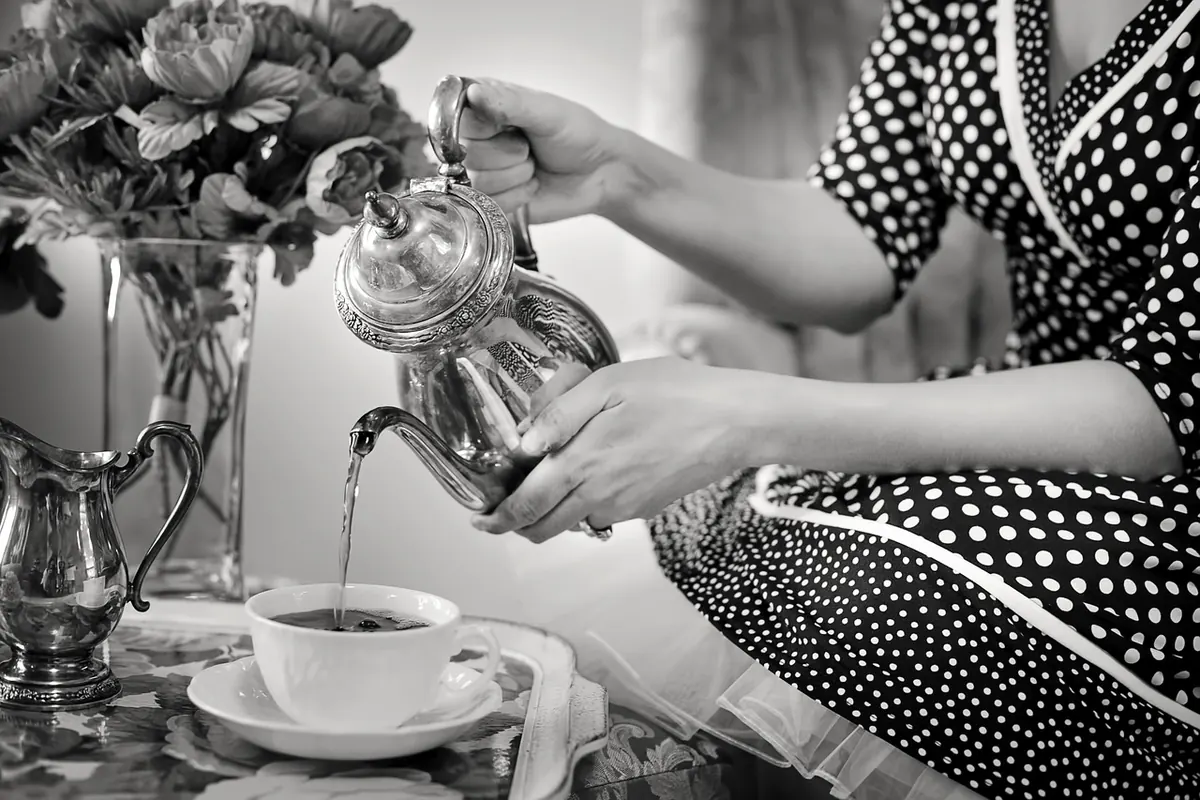
Milk is the real test. The old rule is milk in first, and it comes from a time when delicate china could crack under boiling water and when tea was strong enough to need softening. In practice: if the tea is being poured from a pot into your cup, milk goes in first so it mixes as the tea goes in. If the tea is already in your cup, add milk last, and add less than you think. You can always add more, and you cannot take it out.
Stir gently, back and forth, without clinking the spoon against the sides, and never leave the spoon standing in the cup. If you take sugar, one lump is not a test of character.
Hold the cup by the handle, and when you drink, lift the cup rather than the saucer. The little finger stays down. Pinkies-up is a myth and looks affected.
Table Manners That Actually Matter
- Napkin on your lap, folded, not tucked into your collar and not crumpled on the plate.
- One hand at a time. Rest the cup on its saucer between sips.
- Small bites. Cut a sandwich in half rather than trying to take a whole one in a single mouthful.
- Take from your side of the stand and pass things rather than reaching across the table.
- Ask, don't lunge. If you cannot reach the jam, ask for it to be passed.
- Phone away, or at least face down. Afternoon tea is deliberately slow.
- Don't comment on what others eat. Some people leave the cream, some take two cakes, and neither is your business.
The Mistakes Beginners Make
Most missteps come from treating afternoon tea like a buffet or like lunch. A few to avoid:
- Loading everything onto your plate at once and eating it in a race.
- Eating the scone in one piece, or building it into a four-layer sandwich.
- Picking the crusts off a sandwich that has already been trimmed and cut for you.
- Asking for coffee, or for a knife to eat a pastry that is meant to be eaten by hand.
- Treating the jam-versus-cream debate as something to win.
- Arriving starving. This is a light meal, not dinner.
Practical Things Worth Knowing
- Book ahead. Well-known salons sell out weeks in advance, and most take bookings for a fixed slot.
- Dress neatly. Smart casual is fine almost everywhere; some grand hotels ask for no trainers, shorts or sportswear.
- Tell them in advance about allergies, or a vegetarian or gluten-free diet. Good kitchens will build a separate stand.
- Budget for it. Outside London a full afternoon tea often runs £20–£35 a head; in a famous London hotel it can be £60 or more, service not always included.
- Allow ninety minutes. Rushing defeats the whole point.
- If you are invited to someone's home, bring a small gift — flowers, chocolates or a good tin of tea. Don't bring your own tea to brew, and don't arrive early.
There are few hours in life more agreeable than the hour dedicated to the ceremony known as afternoon tea. — Henry James
That is the whole of it. Sit down, pour carefully, take the sandwich before the scone and the scone before the cake, and let the table talk do the rest. Anyone who makes you feel nervous about the order of your cream has misunderstood the meal entirely.
Photo: JillWellington / Pixabay